Hi All,
I am back with another round of Group Discussion Contest. The topic for this round is
"Was Obama a right candidate for Nobel Peace Prize ?"
Thanks to Abid for the topic suggestion. You will get 100 points.
You can also post your suggestions about topic. Please visit Feedback forum.
To know more about this contest Click Here
We are giving 50 points for all the members who post atleast 3 valid replies on Group Discussion topic. Replies should be in a constructive manner either oppose of supporting the topic.
Wish you all the best and be creative, informative and be sportive in taking feedback.

20 Replies
Really the Nobel prize declaration to Obama was a stunning news to the world and even to Obama also.The Nobel committee says that the award was for his "extra ordinary efforts to strengthen international diplomacy and co-operation".
But he had just told it with his mouth.After a few days with the same mouth he told that it is going to sent 30000 troops to Afganisthan.What is the matter?
US thinks that they are world police and can put hand every thing in the world.Actually people of Afgan hate this troops.But US will have some reason behind any attacks like it had done in Iraq,North Korea etc.
So in my opinion Obama got this prize for a promisory note.If that cheque (!!!)is rebounded will his Nobel be cancelled?
But he had just told it with his mouth.After a few days with the same mouth he told that it is going to sent 30000 troops to Afganisthan.What is the matter?
US thinks that they are world police and can put hand every thing in the world.Actually people of Afgan hate this troops.But US will have some reason behind any attacks like it had done in Iraq,North Korea etc.
So in my opinion Obama got this prize for a promisory note.If that cheque (!!!)is rebounded will his Nobel be cancelled?
10th December A new name added in the history of Noble Prize...
ITS BARACK OBAMA
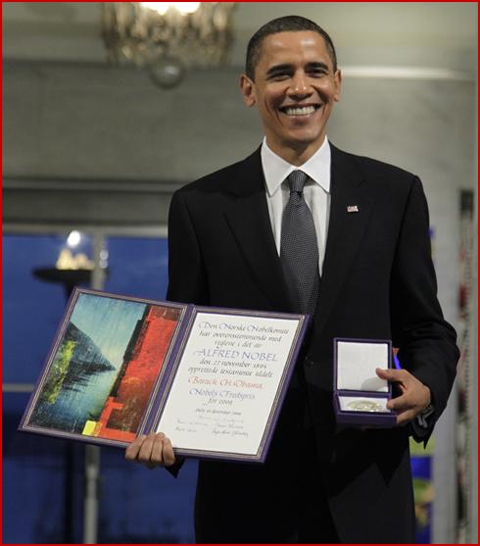
According to Nobel's will, the Peace Prize should be awarded to the person who:
“ ...shall have done the most or the best work for fraternity between nations, for the abolition or reduction of standing armies and for the holding and promotion of peace congresses. "
As per the topic" "Was Obama a right candidate for Nobel Peace Prize ?" I want to say that Obama is the right candidate for the Nobel Prize peace.
Obama awarded for his extraordinary efforts to strengthen international diplomacy and cooperation between peoples. Nobel Committee announced the award on October 9, 2009, for Obama's good work for nuclear nonproliferation and a "new climate" in international relations fostered, specially obama reached out to the muslim world.
Many people are not agree for this award to obama because he increase the army persons in afganistan and they think that it will decrease peace. But it is necessary to control the terrorism. Terrorists will not stop untill they reach to their end. So its a part of creating peace after removing this terrorism. He is the man who take the open challenge fight with terrorists. s these days the way of getting peace is changed.
So i am agree award given to obama.
Lohit seth wrote:
[quote]
According to Nobel's will, the Peace Prize should be awarded to the person who:
“ ...shall have done the most or the best work for fraternity between nations, for the abolition or reduction of standing armies and for the holding and promotion of peace congresses. "
[/quote]
Here is some doubts.
1) What Obama had done to melt the snow between US and its long years enemies like Cuba,North Korea,Iran etc ?To make relation with simply standing countries is not a herculean task.But if he had done something acceptable regarding this countries definitely he will be the right candidate.
2) Abolition or reduction of standing armies...He had ordered to send more troops to Afgan.Definitely it will abolish and reduce standing enemies not armies !!
3) Promotion of peace congress.This definitely he had done through his many speeches and on that one thing itself if he gets this huge prize what prize will he be given if something extra ordinary had done later?
[quote]
According to Nobel's will, the Peace Prize should be awarded to the person who:
“ ...shall have done the most or the best work for fraternity between nations, for the abolition or reduction of standing armies and for the holding and promotion of peace congresses. "
[/quote]
Here is some doubts.
1) What Obama had done to melt the snow between US and its long years enemies like Cuba,North Korea,Iran etc ?To make relation with simply standing countries is not a herculean task.But if he had done something acceptable regarding this countries definitely he will be the right candidate.
2) Abolition or reduction of standing armies...He had ordered to send more troops to Afgan.Definitely it will abolish and reduce standing enemies not armies !!
3) Promotion of peace congress.This definitely he had done through his many speeches and on that one thing itself if he gets this huge prize what prize will he be given if something extra ordinary had done later?
About standing armies, i am completely favour of him. terrorists attached on his country world trade centre. He wanna open fight then its good we also wanna terrorists will get finish, for this he is sending armies. What have done India. Spend more than 800 crore on single terrorist and he alsways change his answer. Obabama also have done so much good works. According to me he is right candidate fir nobel prize.
Sorry for being late.
It is told that it was for his positive steps towards world peace.But many national leaders had given the same type of promisory notes during their crowning ceremoney.Here Obama's crowning was just days before the last date of nomination.Then by chance some one nominated him and the Nobel committee mis judged it.
One more thing.Obama says our father of nation Gandhiji was the inspiration to him.Gandhiji preached and practiced "Ahimsa" and non-violence.Here this man only preaches and practice the contrary (As shown days after his crowning).According to his preaches he may be a right candidate for President of America but surely a wrong candidate for Nobel peace prize.
It is told that it was for his positive steps towards world peace.But many national leaders had given the same type of promisory notes during their crowning ceremoney.Here Obama's crowning was just days before the last date of nomination.Then by chance some one nominated him and the Nobel committee mis judged it.
One more thing.Obama says our father of nation Gandhiji was the inspiration to him.Gandhiji preached and practiced "Ahimsa" and non-violence.Here this man only preaches and practice the contrary (As shown days after his crowning).According to his preaches he may be a right candidate for President of America but surely a wrong candidate for Nobel peace prize.
Abid obama says our father gandhiji was the inspiration to him. Gandhiji like Ahinsa. But noe the time has been changed, If you are inspire from some body then its not mean to do as same what that person have done from which your are inspired. There is a difference between student and the teacher. He can learn from teacher but its not mean he will do in same style or manner as his teacher have done.
Here Obama Giving Comments after getting nobel prize.
Describing himself as surprised and deeply humbled, Obama said he would accept the award as a "call to action" to confront the global challenges of the 21st century.
"I do not view it as a recognition of my own accomplishments but rather an affirmation of American leadership on behalf of aspirations held by people in all nations," he said in the White House Rose Garden.
The Norwegian Nobel Committee praised Obama for "his extraordinary efforts to strengthen international diplomacy and cooperation between peoples," citing his fledgling push for nuclear disarmament and his outreach to the Muslim world.
Obama, a Democrat who took office as the first black U.S. president in January, has been widely credited with improving America's global image after the eight-year presidency of George W. Bush, who alienated both friends and foes with go-it-alone policies like the 2003 U.S.-led invasion of Iraq.
But critics called the Nobel committee's decision premature, given that Obama has achieved few tangible gains as he grapples with challenges ranging from the war in Afghanistan and the Israeli-Palestinian conflict to nuclear standoffs with Iran and North Korea.
Obama, told of the prize in a pre-dawn call from his press secretary, now also has the burden of living up to its expectations.
The president, who will travel to Oslo to receive the award on December 10, plans to donate the prize money of 10 million Swedish crowns -- roughly $1.4 million -- to charity, the White House said.
So I am completely in the favor of Barack Obama
Here Obama Giving Comments after getting nobel prize.
Describing himself as surprised and deeply humbled, Obama said he would accept the award as a "call to action" to confront the global challenges of the 21st century.
"I do not view it as a recognition of my own accomplishments but rather an affirmation of American leadership on behalf of aspirations held by people in all nations," he said in the White House Rose Garden.
The Norwegian Nobel Committee praised Obama for "his extraordinary efforts to strengthen international diplomacy and cooperation between peoples," citing his fledgling push for nuclear disarmament and his outreach to the Muslim world.
Obama, a Democrat who took office as the first black U.S. president in January, has been widely credited with improving America's global image after the eight-year presidency of George W. Bush, who alienated both friends and foes with go-it-alone policies like the 2003 U.S.-led invasion of Iraq.
But critics called the Nobel committee's decision premature, given that Obama has achieved few tangible gains as he grapples with challenges ranging from the war in Afghanistan and the Israeli-Palestinian conflict to nuclear standoffs with Iran and North Korea.
Obama, told of the prize in a pre-dawn call from his press secretary, now also has the burden of living up to its expectations.
The president, who will travel to Oslo to receive the award on December 10, plans to donate the prize money of 10 million Swedish crowns -- roughly $1.4 million -- to charity, the White House said.
So I am completely in the favor of Barack Obama
Lohit seth wrote:
[quote] If you are inspire from some body then its not mean to do as same what that person have done from which your are inspired. [/quote]
Right.But acting totally opposite to the view of inspired person is a fake practice.Inspiration is the result of the activities of a person.That practice will be followed or just kept in mind when we follows him.Here Obama does just opposite.
Unlike the previous US Presidents Obama crowned in when America was going through a lot of crisis.Fortunately Obama had a tongue with whose power he was able to sooth the crowd.He created hopes in US minds.The Nobel committee also got trapped by the same tongue.
You just look the example of recession.Obama told within a year US will regain its power.This gave hopes to many of its citizens.But what is the condition still?One of my cousin in US says things hadn't progressed after this man's crowning.
In his address to Islamic countries he had given some offers regarding the US policy towards them.All knows that US is the arm provider of Israel which massacres thousands of innocent Palestinians daily.Is there any change after Obama's crowning or after confering him Nobel peace prize ?
Like almost all politicians do, Obama also donated the surprise gift prize money for charity.That is only a political stunt.
[quote] If you are inspire from some body then its not mean to do as same what that person have done from which your are inspired. [/quote]
Right.But acting totally opposite to the view of inspired person is a fake practice.Inspiration is the result of the activities of a person.That practice will be followed or just kept in mind when we follows him.Here Obama does just opposite.
Unlike the previous US Presidents Obama crowned in when America was going through a lot of crisis.Fortunately Obama had a tongue with whose power he was able to sooth the crowd.He created hopes in US minds.The Nobel committee also got trapped by the same tongue.
You just look the example of recession.Obama told within a year US will regain its power.This gave hopes to many of its citizens.But what is the condition still?One of my cousin in US says things hadn't progressed after this man's crowning.
In his address to Islamic countries he had given some offers regarding the US policy towards them.All knows that US is the arm provider of Israel which massacres thousands of innocent Palestinians daily.Is there any change after Obama's crowning or after confering him Nobel peace prize ?
Like almost all politicians do, Obama also donated the surprise gift prize money for charity.That is only a political stunt.
[quote]But acting totally opposite to the view of inspired person is a fake practice.Inspiration is the result of the activities of a person.That practice will be followed or just kept in mind when we follows him.Here Obama does just opposite.[/quote]
I am saying he is doing in his manner no matter he is opposite. Target should be same.About recession yes Us the financial environment is not so much good. My relatives are also in America they told me that conditions are not so much bad. You should think abid America is the only country which got maximum bad effects through recession. so for a big country like America A lot of time need to cover it and its getting cover slowly slowly.
Obama creates hopes in Us minds then he fill also fulfill it. He is a very true person. If he have the power of tongue then he also have the power of fullfil the hopes.
And he is the president who comes forward in the worst time of Us which is Recession time.
It is the duty of Us to provide arm to that countries for which they have tie-up. Obama gives his Nobel cash into charity. Then its your thinking that he is doing politics. but its dependa upon the thinking people. Who knows, he is doing politics or give this cash for Noble cause. So i think he gives it for Noble cause. you think its politics.
Us is the arm provider then its their duty because he is the best in power. If india will need arms during any need then US will also gives.
Obama Will do but every good process take time so we have to wait for it.
I am saying he is doing in his manner no matter he is opposite. Target should be same.About recession yes Us the financial environment is not so much good. My relatives are also in America they told me that conditions are not so much bad. You should think abid America is the only country which got maximum bad effects through recession. so for a big country like America A lot of time need to cover it and its getting cover slowly slowly.
Obama creates hopes in Us minds then he fill also fulfill it. He is a very true person. If he have the power of tongue then he also have the power of fullfil the hopes.
And he is the president who comes forward in the worst time of Us which is Recession time.
It is the duty of Us to provide arm to that countries for which they have tie-up. Obama gives his Nobel cash into charity. Then its your thinking that he is doing politics. but its dependa upon the thinking people. Who knows, he is doing politics or give this cash for Noble cause. So i think he gives it for Noble cause. you think its politics.
Us is the arm provider then its their duty because he is the best in power. If india will need arms during any need then US will also gives.
Obama Will do but every good process take time so we have to wait for it.
In first month of obama as president he works this..
American Recovery and Reinvestment Act
Less than a month in office, signs into law the $787 billion stimulus plan, the largest spending bill in the country's history. The package garners three Republican votes in the Senate, none in the House.
Major elements include infrastructure spending, expanded unemployment benefits, increased food stamps, aid to states to pay for Medicaid and tax breaks for individuals and businesses.
Estimates the bill will result in 3 million to 4 million jobs saved or created.
Senate passes $787 billion economic recovery act.
Its is a great job.
In his first 7 months in office:
So sending armies to the afganisthan is the present need.
So i am in the favor of Nobel prize given to Barack Obama.
American Recovery and Reinvestment Act
Less than a month in office, signs into law the $787 billion stimulus plan, the largest spending bill in the country's history. The package garners three Republican votes in the Senate, none in the House.
Major elements include infrastructure spending, expanded unemployment benefits, increased food stamps, aid to states to pay for Medicaid and tax breaks for individuals and businesses.
Estimates the bill will result in 3 million to 4 million jobs saved or created.
Senate passes $787 billion economic recovery act.
Its is a great job.
In his first 7 months in office:
He has so far passed an economic recovery bill which has met mixed criticism but is slowly progressing. He has passed the AMD Stabilization and Support bill which was tailored to help stabilize and strengthen the United States Military, and has shown improvement within the standard. President Obama has also been working on other proposals, bills, and acts to be passed on topics such as Health Care reform, Education, the Mortgage crisis, the war on Al-Qaeda, and Domestic policy.
So sending armies to the afganisthan is the present need.
So i am in the favor of Nobel prize given to Barack Obama.
OK...So within a period of seven months his contribution to keep world peace is the promising of sending additional troops to Afganisthan and pulling out troops from Iraq!!!
Actually both of this countries civilians hate the presence of US troop there.So that people should be given Nobel Peace Prize for not turning so violent against this army!!!
Actually both of this countries civilians hate the presence of US troop there.So that people should be given Nobel Peace Prize for not turning so violent against this army!!!
US amry is the need of pakistan and afganisthan to stay there because pakistan army or afganisthan army can't handle terrorist at their own power. One thing rememberr abid always.. Makse as more as peasce you can in the world but If terrorists will not get finish then there can't be any peace in the world. He is the man who has taken the open challenge at the risk of his life with terrorist.
When a group of terrorists work in a country it is the duty of country to oppose it.Lohit as you told Pakistan and Afganisthan are not able to control terrorists in their country.But who told US to interfere acting as world police?Then what is the need of UN?America had made UN a doll and beleives that UN is under them.That is the greatest problem that world facing now.
US is just a country like any other country in the world.Just like their supremacy all countries have their own supremacy.If a country needs help they will request.But here US just attacks.
Why they don't interfere in Palestine eventhough it started years ago than this gulf crisis and 9/11 incident?Simply because Israel is their companion.Also they will get nothing by helping Palestine.On the otherhand in Gulf they get enough oil.Regarding Afgan also the future oil resources are found to be there.That is the interest of US.
You says Obama is the man who challenged terrorists.Then were the previous presidents were sleeping in White House?
US is just a country like any other country in the world.Just like their supremacy all countries have their own supremacy.If a country needs help they will request.But here US just attacks.
Why they don't interfere in Palestine eventhough it started years ago than this gulf crisis and 9/11 incident?Simply because Israel is their companion.Also they will get nothing by helping Palestine.On the otherhand in Gulf they get enough oil.Regarding Afgan also the future oil resources are found to be there.That is the interest of US.
You says Obama is the man who challenged terrorists.Then were the previous presidents were sleeping in White House?
Abid Areacode wrote:
[quote]
You says Obama is the man who challenged terrorists.Then were the previous presidents were sleeping in White House?[/quote]
Other Preseidents were not sleeping in the white house but BUSH attacked on the IRAQ which was not so much beneficial. But not any President of the Us has taken open challenge. But Obama Came forward.
Abid Palestine never tries to attack on the US. But the terrorists in Pakistan and Afagnistan attacks on the america( which is the main power). Every body remembers that day of falling of World Trade centre. India have very close relations with US. Terrorists Attacked on mumbai where so much US people also get died in hotel.
An Us is the only country in the world who have best arms. The best attacking jets, such kind of aeroplanes which not visible easily in sky and attack easily. So america also improve the condition related to terrorists in Pakistan and Afganistan.
And if there is no need then obama will not send armies there, bu t there is need there so he is sending.. So i am completely in the favor Of Obama.
[quote]
You says Obama is the man who challenged terrorists.Then were the previous presidents were sleeping in White House?[/quote]
Other Preseidents were not sleeping in the white house but BUSH attacked on the IRAQ which was not so much beneficial. But not any President of the Us has taken open challenge. But Obama Came forward.
Abid Palestine never tries to attack on the US. But the terrorists in Pakistan and Afagnistan attacks on the america( which is the main power). Every body remembers that day of falling of World Trade centre. India have very close relations with US. Terrorists Attacked on mumbai where so much US people also get died in hotel.
An Us is the only country in the world who have best arms. The best attacking jets, such kind of aeroplanes which not visible easily in sky and attack easily. So america also improve the condition related to terrorists in Pakistan and Afganistan.
And if there is no need then obama will not send armies there, bu t there is need there so he is sending.. So i am completely in the favor Of Obama.
Hello Abid, you were saying about the war started by Obama in Pakistan and Afganishtan. And you are against with the sending of armies there. So Read this words of Obama which he had spoken during the Nobel Prize giving function. I just giving his some words…..
I think now you will get satisfied with my answer after reading these obama words.. related to the Peace of World.
Of course, we know that for most of history, this concept of "just war" was rarely observed. The capacity of human beings to think up new ways to kill one another proved inexhaustible, as did our capacity to exempt from mercy those who look different or pray to a different God. Wars between armies gave way to wars between nations – total wars in which the distinction between combatant and civilian became blurred. In the span of 30 years, such carnage would twice engulf this continent.
And while it's hard to conceive of a cause more just than the defeat of the Third Reich and the Axis powers, World War II was a conflict in which the total number of civilians who died exceeded the number of soldiers who perished. In the wake of such destruction, and with the advent of the nuclear age, it became clear to victor and vanquished alike that the world needed institutions to prevent another world war. And so, a quarter century after the United States Senate rejected the League of Nations – an idea for which Woodrow Wilson received this prize – America led the world in constructing an architecture to keep the peace: a Marshall Plan and a United Nations, mechanisms to govern the waging of war, treaties to protect human rights, prevent genocide, restrict the most dangerous weapons. In many ways, these efforts succeeded.
Yes, terrible wars have been fought, and atrocities committed. But there has been no Third World War. The Cold War ended with jubilant crowds dismantling a wall. Commerce has stitched much of the world together. Billions have been lifted from poverty. The ideals of liberty and self-determination, equality and the rule of law have haltingly advanced. We are the heirs of the fortitude and foresight of generations past, and it is a legacy for which my own country is rightfully proud. And yet, a decade into a new century, this old architecture is buckling under the weight of new threats.
The world may no longer shudder at the prospect of war between two nuclear superpowers, but proliferation may increase the risk of catastrophe. Terrorism has long been a tactic, but modern technology allows a few small men with outsized rage to murder innocents on a horrific scale. Moreover, wars between nations have increasingly given way to wars within nations. The resurgence of ethnic or sectarian conflicts; the growth of secessionist movements, insurgencies, and failed states – all these things have increasingly trapped civilians in unending chaos. In today's wars, many more civilians are killed than soldiers; the seeds of future conflict are sown, economies are wrecked, civil societies torn asunder, refugees amassed, children scarred. I do not bring with me today a definitive solution to the problems of war. What I do know is that meeting these challenges will require the same vision, hard work, and persistence of those men and women who acted so boldly decades ago. And it will require us to think in new ways about the notions of just war and the imperatives of a just peace. We must begin by acknowledging the hard truth: We will not eradicate violent conflict in our lifetimes.
There will be times when nations – acting individually or in concert – will find the use of force not only necessary but morally justified. I make this statement mindful of what Martin Luther King Jr. said in this same ceremony years ago: "Violence never brings permanent peace. It solves no social problem: it merely creates new and more complicated ones." As someone who stands here as a direct consequence of Dr. King's life work, I am living testimony to the moral force of non-violence. I know there's nothing weak – nothing passive – nothing naïve – in the creed and lives of Gandhi and King. But as a head of state sworn to protect and defend my nation, I cannot be guided by their examples alone. I face the world as it is, and cannot stand idle in the face of threats to the American people. For make no mistake: Evil does exist in the world. A non-violent movement could not have halted Hitler's armies. Negotiations cannot convince al Qaeda's leaders to lay down their arms. To say that force may sometimes be necessary is not a call to cynicism – it is a recognition of history; the imperfections of man and the limits of reason.
I raise this point, I begin with this point because in many countries there is a deep ambivalence about military action today, no matter what the cause. And at times, this is joined by a reflexive suspicion of America, the world's sole military superpower. But the world must remember that it was not simply international institutions – not just treaties and declarations – that brought stability to a post-World War II world. Whatever mistakes we have made, the plain fact is this: The United States of America has helped underwrite global security for more than six decades with the blood of our citizens and the strength of our arms. The service and sacrifice of our men and women in uniform has promoted peace and prosperity from Germany to Korea, and enabled democracy to take hold in places like the Balkans. We have borne this burden not because we seek to impose our will. We have done so out of enlightened self-interest – because we seek a better future for our children and grandchildren, and we believe that their lives will be better if others' children and grandchildren can live in freedom and prosperity. So yes, the instruments of war do have a role to play in preserving the peace.
And yet this truth must coexist with another – that no matter how justified, war promises human tragedy. The soldier's courage and sacrifice is full of glory, expressing devotion to country, to cause, to comrades in arms. But war itself is never glorious, and we must never trumpet it as such. So part of our challenge is reconciling these two seemingly inreconcilable truths – that war is sometimes necessary, and war at some level is an expression of human folly. Concretely, we must direct our effort to the task that President Kennedy called for long ago. "Let us focus," he said, "on a more practical, more attainable peace, based not on a sudden revolution in human nature but on a gradual evolution in human institutions." A gradual evolution of human institutions.
What might this evolution look like? What might these practical steps be? To begin with, I believe that all nations – strong and weak alike – must adhere to standards that govern the use of force. I – like any head of state – reserve the right to act unilaterally if necessary to defend my nation. Nevertheless, I am convinced that adhering to standards, international standards, strengthens those who do, and isolates and weakens those who don't.
The world rallied around America after the 9/11 attacks, and continues to support our efforts in Afghanistan, because of the horror of those senseless attacks and the recognized principle of self-defense. Likewise, the world recognized the need to confront Saddam Hussein when he invaded Kuwait – a consensus that sent a clear message to all about the cost of aggression. Furthermore, America – in fact, no nation – can insist that others follow the rules of the road if we refuse to follow them ourselves. For when we don't, our actions appear arbitrary and undercut the legitimacy of future interventions, no matter how justified. And this becomes particularly important when the purpose of military action extends beyond self-defense or the defense of one nation against an aggressor.
More and more, we all confront difficult questions about how to prevent the slaughter of civilians by their own government, or to stop a civil war whose violence and suffering can engulf an entire region. I believe that force can be justified on humanitarian grounds, as it was in the Balkans, or in other places that have been scarred by war. Inaction tears at our conscience and can lead to more costly intervention later. That's why all responsible nations must embrace the role that militaries with a clear mandate can play to keep the peace. America's commitment to global security will never waver. But in a world in which threats are more diffuse, and missions more complex, America cannot act alone. America alone cannot secure the peace. This is true in Afghanistan. This is true in failed states like Somalia, where terrorism and piracy is joined by famine and human suffering. And sadly, it will continue to be true in unstable regions for years to come. The leaders and soldiers of NATO countries, and other friends and allies, demonstrate this truth through the capacity and courage they've shown in Afghanistan.
But in many countries, there is a disconnect between the efforts of those who serve and the ambivalence of the broader public. I understand why war is not popular, but I also know this: The belief that peace is desirable is rarely enough to achieve it. Peace requires responsibility. Peace entails sacrifice. That's why NATO continues to be indispensable. That's why we must strengthen U.N. and regional peacekeeping, and not leave the task to a few countries. That's why we honor those who return home from peacekeeping and training abroad to Oslo and Rome; to Ottawa and Sydney; to Dhaka and Kigali – we honor them not as makers of war, but of wagers – but as wagers of peace. Let me make one final point about the use of force. Even as we make difficult decisions about going to war, we must also think clearly about how we fight it.
The Nobel Committee recognized this truth in awarding its first prize for peace to Henry Dunant – the founder of the Red Cross, and a driving force behind the Geneva Conventions. Where force is necessary, we have a moral and strategic interest in binding ourselves to certain rules of conduct. And even as we confront a vicious adversary that abides by no rules, I believe the United States of America must remain a standard bearer in the conduct of war. That is what makes us different from those whom we fight. That is a source of our strength. That is why I prohibited torture. That is why I ordered the prison at Guantanamo Bay closed. And that is why I have reaffirmed America's commitment to abide by the Geneva Conventions. We lose ourselves when we compromise the very ideals that we fight to defend. And we honor – we honor those ideals by upholding them not when it's easy, but when it is hard. I have spoken at some length to the question that must weigh on our minds and our hearts as we choose to wage war. But let me now turn to our effort to avoid such tragic choices, and speak of three ways that we can build a just and lasting peace.
First, in dealing with those nations that break rules and laws, I believe that we must develop alternatives to violence that are tough enough to actually change behavior – for if we want a lasting peace, then the words of the international community must mean something. Those regimes that break the rules must be held accountable. Sanctions must exact a real price. Intransigence must be met with increased pressure – and such pressure exists only when the world stands together as one. One urgent example is the effort to prevent the spread of nuclear weapons, and to seek a world without them. In the middle of the last century, nations agreed to be bound by a treaty whose bargain is clear: All will have access to peaceful nuclear power; those without nuclear weapons will forsake them; and those with nuclear weapons will work towards disarmament. I am committed to upholding this treaty.
It is a centerpiece of my foreign policy. And I'm working with President Medvedev to reduce America and Russia's nuclear stockpiles. But it is also incumbent upon all of us to insist that nations like Iran and North Korea do not game the system. Those who claim to respect international law cannot avert their eyes when those laws are flouted. Those who care for their own security cannot ignore the danger of an arms race in the Middle East or East Asia. Those who seek peace cannot stand idly by as nations arm themselves for nuclear war. The same principle applies to those who violate international laws by brutalizing their own people. When there is genocide in Darfur, systematic rape in Congo, repression in Burma – there must be consequences. Yes, there will be engagement; yes, there will be diplomacy – but there must be consequences when those things fail. And the closer we stand together, the less likely we will be faced with the choice between armed intervention and complicity in oppression. This brings me to a second point – the nature of the peace that we seek. For peace is not merely the absence of visible conflict. Only a just peace based on the inherent rights and dignity of every individual can truly be lasting. It was this insight that drove drafters of the Universal Declaration of Human Rights after the Second World War. In the wake of devastation, they recognized that if human rights are not protected, peace is a hollow promise.
And yet too often, these words are ignored. For some countries, the failure to uphold human rights is excused by the false suggestion that these are somehow Western principles, foreign to local cultures or stages of a nation's development. And within America, there has long been a tension between those who describe themselves as realists or idealists – a tension that suggests a stark choice between the narrow pursuit of interests or an endless campaign to impose our values around the world. I reject these choices. I believe that peace is unstable where citizens are denied the right to speak freely or worship as they please; choose their own leaders or assemble without fear. Pent-up grievances fester, and the suppression of tribal and religious identity can lead to violence. We also know that the opposite is true. Only when Europe became free did it finally find peace. America has never fought a war against a democracy, and our closest friends are governments that protect the rights of their citizens. No matter how callously defined, neither America's interests – nor the world's – are served by the denial of human aspirations. So even as we respect the unique culture and traditions of different countries, America will always be a voice for those aspirations that are universal. We will bear witness to the quiet dignity of reformers like Aung Sang Suu Kyi; to the bravery of Zimbabweans who cast their ballots in the face of beatings; to the hundreds of thousands who have marched silently through the streets of Iran. It is telling that the leaders of these governments fear the aspirations of their own people more than the power of any other nation. And it is the responsibility of all free people and free nations to make clear that these movements – these movements of hope and history – they have us on their side.
And while it's hard to conceive of a cause more just than the defeat of the Third Reich and the Axis powers, World War II was a conflict in which the total number of civilians who died exceeded the number of soldiers who perished. In the wake of such destruction, and with the advent of the nuclear age, it became clear to victor and vanquished alike that the world needed institutions to prevent another world war. And so, a quarter century after the United States Senate rejected the League of Nations – an idea for which Woodrow Wilson received this prize – America led the world in constructing an architecture to keep the peace: a Marshall Plan and a United Nations, mechanisms to govern the waging of war, treaties to protect human rights, prevent genocide, restrict the most dangerous weapons. In many ways, these efforts succeeded.
Yes, terrible wars have been fought, and atrocities committed. But there has been no Third World War. The Cold War ended with jubilant crowds dismantling a wall. Commerce has stitched much of the world together. Billions have been lifted from poverty. The ideals of liberty and self-determination, equality and the rule of law have haltingly advanced. We are the heirs of the fortitude and foresight of generations past, and it is a legacy for which my own country is rightfully proud. And yet, a decade into a new century, this old architecture is buckling under the weight of new threats.
The world may no longer shudder at the prospect of war between two nuclear superpowers, but proliferation may increase the risk of catastrophe. Terrorism has long been a tactic, but modern technology allows a few small men with outsized rage to murder innocents on a horrific scale. Moreover, wars between nations have increasingly given way to wars within nations. The resurgence of ethnic or sectarian conflicts; the growth of secessionist movements, insurgencies, and failed states – all these things have increasingly trapped civilians in unending chaos. In today's wars, many more civilians are killed than soldiers; the seeds of future conflict are sown, economies are wrecked, civil societies torn asunder, refugees amassed, children scarred. I do not bring with me today a definitive solution to the problems of war. What I do know is that meeting these challenges will require the same vision, hard work, and persistence of those men and women who acted so boldly decades ago. And it will require us to think in new ways about the notions of just war and the imperatives of a just peace. We must begin by acknowledging the hard truth: We will not eradicate violent conflict in our lifetimes.
There will be times when nations – acting individually or in concert – will find the use of force not only necessary but morally justified. I make this statement mindful of what Martin Luther King Jr. said in this same ceremony years ago: "Violence never brings permanent peace. It solves no social problem: it merely creates new and more complicated ones." As someone who stands here as a direct consequence of Dr. King's life work, I am living testimony to the moral force of non-violence. I know there's nothing weak – nothing passive – nothing naïve – in the creed and lives of Gandhi and King. But as a head of state sworn to protect and defend my nation, I cannot be guided by their examples alone. I face the world as it is, and cannot stand idle in the face of threats to the American people. For make no mistake: Evil does exist in the world. A non-violent movement could not have halted Hitler's armies. Negotiations cannot convince al Qaeda's leaders to lay down their arms. To say that force may sometimes be necessary is not a call to cynicism – it is a recognition of history; the imperfections of man and the limits of reason.
I raise this point, I begin with this point because in many countries there is a deep ambivalence about military action today, no matter what the cause. And at times, this is joined by a reflexive suspicion of America, the world's sole military superpower. But the world must remember that it was not simply international institutions – not just treaties and declarations – that brought stability to a post-World War II world. Whatever mistakes we have made, the plain fact is this: The United States of America has helped underwrite global security for more than six decades with the blood of our citizens and the strength of our arms. The service and sacrifice of our men and women in uniform has promoted peace and prosperity from Germany to Korea, and enabled democracy to take hold in places like the Balkans. We have borne this burden not because we seek to impose our will. We have done so out of enlightened self-interest – because we seek a better future for our children and grandchildren, and we believe that their lives will be better if others' children and grandchildren can live in freedom and prosperity. So yes, the instruments of war do have a role to play in preserving the peace.
And yet this truth must coexist with another – that no matter how justified, war promises human tragedy. The soldier's courage and sacrifice is full of glory, expressing devotion to country, to cause, to comrades in arms. But war itself is never glorious, and we must never trumpet it as such. So part of our challenge is reconciling these two seemingly inreconcilable truths – that war is sometimes necessary, and war at some level is an expression of human folly. Concretely, we must direct our effort to the task that President Kennedy called for long ago. "Let us focus," he said, "on a more practical, more attainable peace, based not on a sudden revolution in human nature but on a gradual evolution in human institutions." A gradual evolution of human institutions.
What might this evolution look like? What might these practical steps be? To begin with, I believe that all nations – strong and weak alike – must adhere to standards that govern the use of force. I – like any head of state – reserve the right to act unilaterally if necessary to defend my nation. Nevertheless, I am convinced that adhering to standards, international standards, strengthens those who do, and isolates and weakens those who don't.
The world rallied around America after the 9/11 attacks, and continues to support our efforts in Afghanistan, because of the horror of those senseless attacks and the recognized principle of self-defense. Likewise, the world recognized the need to confront Saddam Hussein when he invaded Kuwait – a consensus that sent a clear message to all about the cost of aggression. Furthermore, America – in fact, no nation – can insist that others follow the rules of the road if we refuse to follow them ourselves. For when we don't, our actions appear arbitrary and undercut the legitimacy of future interventions, no matter how justified. And this becomes particularly important when the purpose of military action extends beyond self-defense or the defense of one nation against an aggressor.
More and more, we all confront difficult questions about how to prevent the slaughter of civilians by their own government, or to stop a civil war whose violence and suffering can engulf an entire region. I believe that force can be justified on humanitarian grounds, as it was in the Balkans, or in other places that have been scarred by war. Inaction tears at our conscience and can lead to more costly intervention later. That's why all responsible nations must embrace the role that militaries with a clear mandate can play to keep the peace. America's commitment to global security will never waver. But in a world in which threats are more diffuse, and missions more complex, America cannot act alone. America alone cannot secure the peace. This is true in Afghanistan. This is true in failed states like Somalia, where terrorism and piracy is joined by famine and human suffering. And sadly, it will continue to be true in unstable regions for years to come. The leaders and soldiers of NATO countries, and other friends and allies, demonstrate this truth through the capacity and courage they've shown in Afghanistan.
But in many countries, there is a disconnect between the efforts of those who serve and the ambivalence of the broader public. I understand why war is not popular, but I also know this: The belief that peace is desirable is rarely enough to achieve it. Peace requires responsibility. Peace entails sacrifice. That's why NATO continues to be indispensable. That's why we must strengthen U.N. and regional peacekeeping, and not leave the task to a few countries. That's why we honor those who return home from peacekeeping and training abroad to Oslo and Rome; to Ottawa and Sydney; to Dhaka and Kigali – we honor them not as makers of war, but of wagers – but as wagers of peace. Let me make one final point about the use of force. Even as we make difficult decisions about going to war, we must also think clearly about how we fight it.
The Nobel Committee recognized this truth in awarding its first prize for peace to Henry Dunant – the founder of the Red Cross, and a driving force behind the Geneva Conventions. Where force is necessary, we have a moral and strategic interest in binding ourselves to certain rules of conduct. And even as we confront a vicious adversary that abides by no rules, I believe the United States of America must remain a standard bearer in the conduct of war. That is what makes us different from those whom we fight. That is a source of our strength. That is why I prohibited torture. That is why I ordered the prison at Guantanamo Bay closed. And that is why I have reaffirmed America's commitment to abide by the Geneva Conventions. We lose ourselves when we compromise the very ideals that we fight to defend. And we honor – we honor those ideals by upholding them not when it's easy, but when it is hard. I have spoken at some length to the question that must weigh on our minds and our hearts as we choose to wage war. But let me now turn to our effort to avoid such tragic choices, and speak of three ways that we can build a just and lasting peace.
First, in dealing with those nations that break rules and laws, I believe that we must develop alternatives to violence that are tough enough to actually change behavior – for if we want a lasting peace, then the words of the international community must mean something. Those regimes that break the rules must be held accountable. Sanctions must exact a real price. Intransigence must be met with increased pressure – and such pressure exists only when the world stands together as one. One urgent example is the effort to prevent the spread of nuclear weapons, and to seek a world without them. In the middle of the last century, nations agreed to be bound by a treaty whose bargain is clear: All will have access to peaceful nuclear power; those without nuclear weapons will forsake them; and those with nuclear weapons will work towards disarmament. I am committed to upholding this treaty.
It is a centerpiece of my foreign policy. And I'm working with President Medvedev to reduce America and Russia's nuclear stockpiles. But it is also incumbent upon all of us to insist that nations like Iran and North Korea do not game the system. Those who claim to respect international law cannot avert their eyes when those laws are flouted. Those who care for their own security cannot ignore the danger of an arms race in the Middle East or East Asia. Those who seek peace cannot stand idly by as nations arm themselves for nuclear war. The same principle applies to those who violate international laws by brutalizing their own people. When there is genocide in Darfur, systematic rape in Congo, repression in Burma – there must be consequences. Yes, there will be engagement; yes, there will be diplomacy – but there must be consequences when those things fail. And the closer we stand together, the less likely we will be faced with the choice between armed intervention and complicity in oppression. This brings me to a second point – the nature of the peace that we seek. For peace is not merely the absence of visible conflict. Only a just peace based on the inherent rights and dignity of every individual can truly be lasting. It was this insight that drove drafters of the Universal Declaration of Human Rights after the Second World War. In the wake of devastation, they recognized that if human rights are not protected, peace is a hollow promise.
And yet too often, these words are ignored. For some countries, the failure to uphold human rights is excused by the false suggestion that these are somehow Western principles, foreign to local cultures or stages of a nation's development. And within America, there has long been a tension between those who describe themselves as realists or idealists – a tension that suggests a stark choice between the narrow pursuit of interests or an endless campaign to impose our values around the world. I reject these choices. I believe that peace is unstable where citizens are denied the right to speak freely or worship as they please; choose their own leaders or assemble without fear. Pent-up grievances fester, and the suppression of tribal and religious identity can lead to violence. We also know that the opposite is true. Only when Europe became free did it finally find peace. America has never fought a war against a democracy, and our closest friends are governments that protect the rights of their citizens. No matter how callously defined, neither America's interests – nor the world's – are served by the denial of human aspirations. So even as we respect the unique culture and traditions of different countries, America will always be a voice for those aspirations that are universal. We will bear witness to the quiet dignity of reformers like Aung Sang Suu Kyi; to the bravery of Zimbabweans who cast their ballots in the face of beatings; to the hundreds of thousands who have marched silently through the streets of Iran. It is telling that the leaders of these governments fear the aspirations of their own people more than the power of any other nation. And it is the responsibility of all free people and free nations to make clear that these movements – these movements of hope and history – they have us on their side.
I think now you will get satisfied with my answer after reading these obama words.. related to the Peace of World.
As Per Group Discussion Topic
"Was Obama a right candidate for Nobel Peace Prize ?"
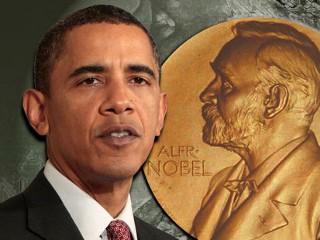
I Think Obama is the right candidate for the Nobel Prize.
I have given a lot of my opinions related to this topic in this discussion. So many persons are there who are talking about the peace. So you can listen or read the words of Obama In his speech while getting prize. He told the meaning of peace in this presnt time and how we can get it. The also don't wanna war. Its the current need to finish the Terrorism.
rohit wrote:
[quote]These americans just talk about the peace but don't do nothing for the peace . if that so . then why the previous president give loan of hundred of million to pakistan for vanishing the terrorism .pakistan used money for the ammunation for providing to terrorist..[/quote]
My dear Rohit I wanna tell you what are you saying..Do you know the mean of your starting lines. If a person of america have done a mistake then you have no rights to blame the people of america. And that the thing you are doing. you are saying "These americans just talk about the peace but don't do nothing for the peace. ". What do u mean by americans. your these lines creating the differences between the people. If a non-indian say these indians are not good, then how do u feel ?. this is not right to blame all the people of a country if a single person of that country do mistake. Firstly improve your thinking then talk about word peace.
I think you also knew that every person have different thinking. Previous president of america give loan of hundred of million to pakistan for vanishing the terrorism , president give pakistan for a noble cause means for finishing the terrorism. But he didn't knew that about " pakistan will do like this type of ditch.". He is a human not god and mistakes happen from human. Now the president has been changed. He is Barack Obama. He openly taken the challenge with terrorist to finish them. Because Obama wants to finish this terrorism. If terrorism will get finish, then peace will automatically comes in our hand.
[quote]These americans just talk about the peace but don't do nothing for the peace . if that so . then why the previous president give loan of hundred of million to pakistan for vanishing the terrorism .pakistan used money for the ammunation for providing to terrorist..[/quote]
My dear Rohit I wanna tell you what are you saying..Do you know the mean of your starting lines. If a person of america have done a mistake then you have no rights to blame the people of america. And that the thing you are doing. you are saying "These americans just talk about the peace but don't do nothing for the peace. ". What do u mean by americans. your these lines creating the differences between the people. If a non-indian say these indians are not good, then how do u feel ?. this is not right to blame all the people of a country if a single person of that country do mistake. Firstly improve your thinking then talk about word peace.
I think you also knew that every person have different thinking. Previous president of america give loan of hundred of million to pakistan for vanishing the terrorism , president give pakistan for a noble cause means for finishing the terrorism. But he didn't knew that about " pakistan will do like this type of ditch.". He is a human not god and mistakes happen from human. Now the president has been changed. He is Barack Obama. He openly taken the challenge with terrorist to finish them. Because Obama wants to finish this terrorism. If terrorism will get finish, then peace will automatically comes in our hand.
Lohith,
Thanks for providing the speach of Obama. But I think the speech was just to put dust on the eyes of the world.Like Mark Antony he is well to use ironies and take the mob in hand.Yes, he should be given Nobel for this ability not for peace!!!
When conferred Nobel Prize he has to justify his selection.He has nothing in hand to justify the prize.So he again used his tomgue and well played with it.That is this speech.Still after getting this can you point anything that he had done for peace in this world except the words???The world summit in Copen Hagen also ended without result due to the fake practice of USA.They are not ready to reduce their production of carbondioxide and other harmful green house gases.Is it good for world peace?If he had commitment to this earth unlike his predecessors he should have to sign Kyoto treaty.
Thanks for providing the speach of Obama. But I think the speech was just to put dust on the eyes of the world.Like Mark Antony he is well to use ironies and take the mob in hand.Yes, he should be given Nobel for this ability not for peace!!!
When conferred Nobel Prize he has to justify his selection.He has nothing in hand to justify the prize.So he again used his tomgue and well played with it.That is this speech.Still after getting this can you point anything that he had done for peace in this world except the words???The world summit in Copen Hagen also ended without result due to the fake practice of USA.They are not ready to reduce their production of carbondioxide and other harmful green house gases.Is it good for world peace?If he had commitment to this earth unlike his predecessors he should have to sign Kyoto treaty.
Abid Areacode wrote:
[quote]Lohith,
Thanks for providing the speach of Obama. But I think the speech was just to put dust on the eyes of the world.Like Mark Antony he is well to use ironies and take the mob in hand.Yes, he should be given Nobel for this ability not for peace!!!
When conferred Nobel Prize he has to justify his selection.He has nothing in hand to justify the prize.So he again used his tomgue and well played with it.That is this speech.Still after getting this can you point anything that he had done for peace in this world except the words???The world summit in Copen Hagen also ended without result due to the fake practice of USA.They are not ready to reduce their production of carbondioxide and other harmful green house gases.Is it good for world peace?If he had commitment to this earth unlike his predecessors he should have to sign Kyoto treaty.[/quote]
Abid, I want to tell you : Obama have the ability thats why he got the Nobel prize. For spreading the peace its not an easy task. Time to time meaning of peace is changing from present to future. He is working for peace and Nobel prize team gave this Nobel prize to him for taking the actions for the peace by him. You can assume his words only words, everything takes times and his words also will take a little bit time for implementing. its not an easy task for a president to say and just implement. Its not a movie. Its a real life. And Nobel Prize Team members are not fool they know to whom they should give this prize and they are doing from many years.
And about the copen Hagen meeting, Its the decision of that country they want to agree with the summit or not. Obama got Nobel Prize for his other works. Here we are not relating copen Hagen with his Nobel prize. You are saying about the decreasing Co2. Ok its right to decrease. But in India what happened at the Jaipur Oil Depot before some times. There was a great fire in that depot and india didn't have the source to stop that. A large number of gases comes in air which makes ill to a large number of people and also effected the climate.
Obama denies the Copen Hagen summit because china was not agree to share the information about the Co2 production in china. China is the biggest Co2 production country in the world. So china is also the country which makes obama to denie this summit. you can not blame obama only. china told that they will not allow any international person to check their Co2 range. then obama said and he said right, what the is the mean of international agreement if you are not agree to share information regarding agreement matter.
So at last i wanna say abid Obama is not only responsible for the failure of this summit, it was happen due the china's negative answer related to summit.
And I think Obama according to his other works and actions he is the right candidate for Nobel Prize.
Not i think you will get satisfied. Thats all.
[quote]Lohith,
Thanks for providing the speach of Obama. But I think the speech was just to put dust on the eyes of the world.Like Mark Antony he is well to use ironies and take the mob in hand.Yes, he should be given Nobel for this ability not for peace!!!
When conferred Nobel Prize he has to justify his selection.He has nothing in hand to justify the prize.So he again used his tomgue and well played with it.That is this speech.Still after getting this can you point anything that he had done for peace in this world except the words???The world summit in Copen Hagen also ended without result due to the fake practice of USA.They are not ready to reduce their production of carbondioxide and other harmful green house gases.Is it good for world peace?If he had commitment to this earth unlike his predecessors he should have to sign Kyoto treaty.[/quote]
Abid, I want to tell you : Obama have the ability thats why he got the Nobel prize. For spreading the peace its not an easy task. Time to time meaning of peace is changing from present to future. He is working for peace and Nobel prize team gave this Nobel prize to him for taking the actions for the peace by him. You can assume his words only words, everything takes times and his words also will take a little bit time for implementing. its not an easy task for a president to say and just implement. Its not a movie. Its a real life. And Nobel Prize Team members are not fool they know to whom they should give this prize and they are doing from many years.
And about the copen Hagen meeting, Its the decision of that country they want to agree with the summit or not. Obama got Nobel Prize for his other works. Here we are not relating copen Hagen with his Nobel prize. You are saying about the decreasing Co2. Ok its right to decrease. But in India what happened at the Jaipur Oil Depot before some times. There was a great fire in that depot and india didn't have the source to stop that. A large number of gases comes in air which makes ill to a large number of people and also effected the climate.
Obama denies the Copen Hagen summit because china was not agree to share the information about the Co2 production in china. China is the biggest Co2 production country in the world. So china is also the country which makes obama to denie this summit. you can not blame obama only. china told that they will not allow any international person to check their Co2 range. then obama said and he said right, what the is the mean of international agreement if you are not agree to share information regarding agreement matter.
So at last i wanna say abid Obama is not only responsible for the failure of this summit, it was happen due the china's negative answer related to summit.
And I think Obama according to his other works and actions he is the right candidate for Nobel Prize.
Not i think you will get satisfied. Thats all.
You just look to previous winners.Our Indian Origin Rajendra Pachouri and his organisation won it for their best works on environmental issues.Wangari Mathai also won for her works on environmental issues.Here after winning the same prize this man does just opposite to the works of his previous one.It is dishonouring them.
Also look to other winners like Kofi Annan, Aungsan Suki etc.All have done something for striving people and not for motivational speech.Here this man had done nothing except some promises
In his election campaign he accused Al Qaeda as the biggest threat to world and his action is concentrated in Afgan against Thaliban which escalated the problem.So words are not matching with action and such a man is given this noble Nobal.
Also look to other winners like Kofi Annan, Aungsan Suki etc.All have done something for striving people and not for motivational speech.Here this man had done nothing except some promises
In his election campaign he accused Al Qaeda as the biggest threat to world and his action is concentrated in Afgan against Thaliban which escalated the problem.So words are not matching with action and such a man is given this noble Nobal.
Topic Author
M
maverick
@maverick
Topic Stats
Created
Monday, 11 January 2010 10:25
Last Updated
Tuesday, 30 November -0001 00:00
Replies
0
Views
5.4K
Likes
0